Showing posts with label Bollywood. Show all posts

Friday, October 26, 2012

Satyajit Ray - India's Master Filmmaker


Filmmaker Satyajit Ray
Regarded as a Master in World Cinema
It was the year of India's Independence from Great Britain in 1947,  when master filmmaker Satyajit Ray helped found the Calcutta Film Society.  He was born in Calcutta in 1921 into a Bengali family prominent in the world of arts and literature.  Ray came to appreciate fine art and his interest grew even stronger after the encouragement of his mother to study at the Visva-Bharati University founded by Rabindranath Tagore (Bengali Nobel Prize Laureate and author of India's National Anthem).  Years later, with Calcutta always in his heart, Ray celebrated his beloved city with the film Mahanagar (The Big City) that dealt with a rare foray of social satire in 1963 whose citizens manage to dream under the most oppressive conditions.

Ray was working as an illustrator and copywriter when he made his debut film, with Pather Panchali (Song of the Little Road) in 1955.  It took three years to complete the film as he was able to work on it only on weekends and had to make ends meet with his regular job.  He used his own savings and the money from the sale of his wife's jewelry.  The film was finally completed thanks to the funding of the government of West Bengal after John Huston, the director of The Queen of Africa encouraged and pushed for support.  Ray was never a popular filmmaker throughout India.  The commercial success of his pictures was restricted by his use of the Bengali language, as opposed to the more widely spoken Hindi.  The indian masses were not used to reading subtitles on films nor were prepared to appreciate narrative art films that did not follow the usual Bollywood formulaic elements: which is the standard for the bulk of indian films that contain melodramatic tones, unrealistic scenarios and life situations, fantasy, glitzy and over the top out of context music and dance numbers.  

Apu in Satyajit Ray's debut film, Pather Panchali, (Song of the Little Road)1955
from the Apy Trilogy
Ray's films spoke clearly to discriminating Western cinema-goers.  His films paid serious attention to plot, storyline, dialogue, and actor performance.  This is not surprising at all as Ray learned his craft and emulated the films he most admired.  He studied closely Victorio de Sica's, The Bicycle Thief (1948), but also hundreds of American films directed by John Ford and Frank Capra.  After helping french filmmaker Jean Renoir on his film, The River (1951), Ray realized he had an opportunity to learn the craft from a master and followed the style and aesthetics that were common in the narrative films of Renoir.  At the time, Renoir's films were often cited by critics as the greatest films ever made.  Renoir travelled to India in 1949 to make his film The River.  Ray admired the way in which Renoir told the story of three young girls coming of age in India.  It was a meditation on human beings' relationship with nature.  

Ray was a lover of many art forms and he had an appreciation for writing, directing, and designing sets, but his other love was music.  He eventually composed many of the scores for his own films.  Ray revealed himself to be a director of moments.  His films spoke to the viewer with a sensuous incandescent quality, mastering one of cinema's most uncanny tricks, the illusion that the camera is somehow able to capture the light from inside a human being.  

Ray turned poverty into beauty displaying an appreciation of nature and found the simple lives of those less privileged to be just as interesting.  Most mainstream Bollywood films portray subjects of wealth and glamour and an untrue reality that only the beautiful and rich can fall in love, enjoy happiness, or dress in beautiful colors.  He became frustrated with Bollywood musical films and turned to a neo-realist style already common in Europe and the US.  The neo-realist style of filmmaking consisted of realism, serious content, natural performances from the actors, and naturalism with a special focus on the sociopolitical issues of the time.  The genre became known as art house films and were in part supported by state governments to promote an authentic art genre from an Indian film fraternity.  Ray's films invoked warm humanism often transmitted through a deceptively simple yet profoundly resonant close-up of the human face: cinema's lingua franca (a working language systematically used to make communication possible between people not sharing a mother tongue).  

Although Ray's films were successful in Western countries, in India, politicians objected when his films were cleared by the film censor (Censor Board of Film Certification).  They complained his films portrayed India in "a very negative light"; "The world will think we have only poverty."  Because of the realism portrayed in his films, cinema-goers did not want to see reality on the screen.  Ray always managed to show the real India thru his films.  During his lifetime this humble master of the cinema had to beg for money for his next film while in the 1960's mainstream Bollywood was awash in black money and undeclared cash fortunes found their way into the film industry.

Ray talked about the hardships he faced in making his first film Pather Panchali in his  essays compiled in a book titled, Our Films Their Films, "When I look back on the making of Pather Panchali, I cannot be sure whether it has meant more pain to me than pleasure.  It is difficult to describe the peculiar torments of a production held up for lack of funds.  The long periods of enforced idleness produce nothing but the deepest gloom.  The very sight of the scenario is sickening, let alone thoughts of embellishing it with details, or bruising up the dialogue."

A still frame from the film Mahanagar (The Big City), 1963
directed by Satyajit Ray
There were three familiar and well trodden paths open to him.  He could make mythological films, or he could make 'devotional' ones, or he could make 'socials' preferably melodramas - which must have adornment of the latest favorite star team.  All three must have the usual concomitant of songs and dances and must not be below two and a half hours in length.  This last proviso is so rigid, and so is the exhibitor's faith in it, that a film that dares to disregard it may never see the light of day.  Needless to say, these formulas do not work every time, but they are the ones that have had the longest and most lucrative existence.  They have evolved out of the producers' deliberate and sustained playing down to a vast body of unsophisticated audience brought up on the simple tradition of the Jatra, a form of rural drama whose broad gestures, loud rhetoric and simple emotional patterns have been retained in the films to a degree unimaginable to those not familiar  with this unique form of filmmaking.  The song and over the top out of context dances are a legacy of the theatrical operatic tradition carried onto film even if all the most awkward.  

Ray assumed his position as a serious filmmaker and the results have been more than gratifying throughout his 37 films that included feature films, documentaries, and shorts.  Ray faced the challenges of contemporary reality and from them drew his subject matter for his films.  It payed to be uncompromising.  He was aware of the consequences of departing from the beaten track, but he was undeterred because he had great faith in his films.  Ray expected no quick returns he is remembered saying, "What is really important and exciting is not the immediate gain, but the ultimate vindication of the belief that I hold dearest as an artist: art wedded to truth in the end have its reward."  

Beloved Satyajit Ray's masterpiece films are a trilogy titled, The Apu Trilogy, consisting of three Bengali films: Pather Panchali (Song of the Little Road), Aparajito (The Unvanquished) and Apu Sansar (The World of Apu), completed from 1955 to 1959.  The films are now regarded as masterpieces in world cinema and have been appreciated by such filmmakers as Martin Scorsese, James Ivory, Abbas Kiarostami, Elia Kazan, Carlos Saura, Isao Takahata, Philip Kaufman, Wes Anderson, Dany Boyle and Akira Kurosawa.  The films went on to win many international and national awards.   

Master Filmmaker Satyajit Ray upon receiving
his Honorary Lifetime Achievement Oscar (1992) 
In 1992, Ray's health deteriorated due to heart complications. He was admitted to a hospital, and would never recover.  In recognition of his rare mastery of the art of motion pictures, and of his profound humanitarian outlook, which has had an indelible influence on filmmakers and audiences throughout the world, an Academy Honorary Oscar from the Motion Picture Arts And Sciences was awarded to him weeks before his death, which he received in a gravely ill condition.  He died on the 23rd of April 1992 at the age of 70.  When a radio announcement was made in Calcutta that their ailing filmmaker had died, people poured out of their homes.  Offices closed and the government was brought to a standstill as buroucrats deserted their desks to give their final respect to the now legendary filmmaker.  

Written by Leticia Alaniz © 2012

Satyajit Ray Filmography:
Pather Panchali (Song of the Road), 1955
Aparajito (The Unvanquished), 1956
Parash Pathar (The Philosopher's Stone), 1958
Jalsaghar (The Music Room), 1958
Apur Sansar (The World of Apu), 1959
Devi (The Goddess), 1960
Teen Kanya (Three Daughters), 1961
Kanchanjungha, 1962
Abhijan (The Expedition), 1962
Mahanagar (The Big City), 1963
Charulata (The Lonely Wife), 1964
Kapurush O Mahapurush (The Coward and The Holy Man), 1965
Nayak (The Hero), 1966
Chiriakhana (The Zoo), 1967
Goopy Gyne Bagha Byne (The Adventures of Goopy and Bagha), 1968
Aranyer Din Ratri (Days and Nights in the Forest), 1969
Pratidwandi (The Adversary), 1970
Seemabaddha (Company Limited), 1971
Ashani Sanket (Distant Thunder), 1973
Sonar Kella (The Golden Fortress), 1974
Jana Aranya (The Middle Man), 1975
Shatranj Ke Khilari (The Chess Players), 1977
Joi Baba Felunath (The Elephant God), 1978
Hirak Rajar Dese (The Kingdom of Diamonds), 1980
Ghare Baire (The Home and the World), 1984
Ganashatru (An Enemy of the People), 1989
Shakha Proshakha (Branches of a Tree), 1990
Agantuk (The Stranger), 1991

Thursday, February 9, 2012

Maqbool Fida Hussain - India's Poster Artist


"I always dreamed of making a film, but it's an expensive medium, so I started painting as a sideline."

The poster artist Maqbool Fida Hussain said acknowledging for himself that it's not a bad sideline.  He was one of the few contemporary Indian painters to have achieved the celebrity of a film star.  His art pieces have sold for crores of rupees and is well known internationally.  The Indian artist got noticed more because of his nude paintings of Hindu Gods and the controversy that followed.

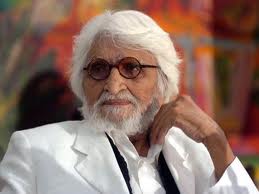
His signature look garnered him plenty of attention for his simplicity in manner of dressing:  an impeccable shirt and thin cotton trousers in white that matched his mane of hair and beard.  Draped around his neck he usually wore a crinkled silk black scarf that looked like a whimsical brushstroke, an artist's signature.  His only other accessory was a pair of tinted spectacles with round frames that gave him an owlish expression.  As always, he was barefoot.  It was one of his trademarks, whether he was traveling abroad, entering the lobby of a five-star hotel, or working in a studio.  Gracefully, he walked with a slim cane that on close inspection, turned out to be an extra-long paint brush.  

His larger-than-life murals of Indira Gandhi dominate the walls of Delhi's international airport.  Indifferent to both religion and politics, Mr. Husain, a muslim by upbringing, treated the gods and goddesses of Hinduism as visual stimuli rather than deities, depicting them unclothed and often in sexually suggestive poses. This cavalier treatment earned him the bitter hatred of Hindu nationalist groups, which beginning in the 1990s mounted a campaign of intimidation and violence against him.  The right-wing zealots criticized all of his art and was tagged too controversial for conservative India. 

At the same time, the big screen was always a part of his imagination.  In the 1930's, M. F. Hussain arrived in Mumbai (then it was called Bombay), as an unknown artist and began his work painting film posters for a total of four annas per square foot.  (Four annas was equal to one-fourth of a rupee way below a US dollar.)  Sadly, none of Hussain's film posters have survived, though he had a photograph of one of the giant billboards he painted at the Minerva Cinema, advertising P. C. Barua's film Zindagi (Life).  Poster artists are still hired by producers, distributers, and cinema owners to paint billboards and posters to advertise their films.  

The artist claimed he was greatly influenced in his later work by the film posters he painted at an early age.  He made three films himself, beginning with a black and white short film commissioned by the government in 1966.  It was called, Through the Eyes of a Painter.  When he first screened the film for the film board, they rejected it, claiming it was juvenile, and that it made no sense.  Soon after, he screened the film for the Berlin Film Festival and it was well received and was awarded a Golden Bear. 

In 2000, Hussain made the film Gaja Gamini.  The title is taken from a Sanskrit expression that describes a woman whose walk is as beautiful as an elephant's gait.  The film is mostly a tribute to the actress Madhuri Dixit.  Hussain admitted being infatuated with her and most of the film revolves around her dancing form. The film failed to attract an audience, though it had a large cast of stars, including Madhuri Dixit, Shabana Azmi, Naseeruddin Shah, and Shah Rukh Khan.  Hussain appears in the film at several points, sketching the image of a horse on a brick wall and painting a tiger on the flank of a live elephant.  

His third film was one in which he directed the Hindi star Tabu in Meenaxi: A Tale of Three Cities, which was released in 2004.  The film was criticized as being a self indulgent and narcissistic story about the artist himself.  It did not accomplish commercial success and was quickly shelved and forgotten. 

Hussain was a great admirer of filmmakers Federico Fellini, Jean-Luc Godard, and Roberto Rossellini, whom he met years ago when the Italian director visited India.  When he was asked about the films Salvador Dalí made with spanish filmmaker Luis Buñuel, Hussain shook his head:

"Dalí was a painter who started with ideas rather than images," he said.  "I prefer images to ideas.  I don't want people to read my paintings.  I want them to look at them.  People always want to know the meaning..."

He applied the formal lessons of European modernists like Picasso, Cézanne, and Matisse to scenes from national epics like the Mahabharata and to the Hindu pantheon.  For which he was dubbed the Picasso of India.  
Among his best-known paintings are a series based on the Ramayana and Mahabharata and a series of 45 watercolors, completed in 1975, “Passage Through Human Space.” Although they're considered his best works, his political troubles stemmed from this body of paintings, made in the early 1970s.  

Because of his controversial artwork, Mr, Hussain was blamed for sparking political and religious tension between hindus and muslims.  An angry mob ransacked his gallery in Ahmedabad, and members of the far-right Hindu group Bajrang Dal invaded his house and vandalized paintings.


Even though he had a knack for provocation, Mr. Husain received many official honors. In 1986, as a reward for his status as a national treasure, he was appointed by Prime Minister Rajiv Gandhi to the upper house of the Indian Parliament.  In his later years, Mr. Husain spent much of his time defending himself against court actions aimed at the messages in his artwork, and in 2005 he left India and became a citizen of Qatar.  After leaving India, Mr. Husain, divided his time between Dubai and London. “They can put me in a jungle, yet still I can create."  He often said of himself having imposed a voluntary exile by choice.  Maqbool Fida Husain was born on Sept. 17, 1915, in Pandharpur, in the central Indian state of Maharashtra, and grew up in Indore in Madhya Pradesh.  He enjoyed a life in art and a bohemian life style earning him the admiration of many and parting this world on June 9, 2011 as the highest paid artist in India.  He was 95.  

Written by Leticia Alaniz © 2012